Medical Glossary
A | B | C | D | E | F | G | H | I | J | K | L | M | N | O | P | Q | R | S | T | U | V | W | X | Y | Z | ALL
G |
|---|
G proteins | |
GeneThe functional and physical unit of heredity passed from parent to offspring. Genes are pieces of DNA, and most genes contain the information for making a specific protein1.
| |
Gene expressionThe process by which a gene gets turned on in a cell to make RNA and proteins. Gene expression may be measured by looking at the RNA, or the protein made from the RNA, or what the protein does in a cell1. Gene expression is the process the cell uses to produce the molecule it needs by reading the genetic code written in the DNA. To do this, the cell interprets the genetic code, and for each group of three letters it adds 1 of the 20 different amino acids that are the basic units needed to build proteins.. The information encoded in a gene is used to direct the assembly of a protein molecule. The cell reads the sequence of the gene in groups of three bases. Each group of three bases (codon) corresponds to one of 20 different amino acids used to build the protein24. Genes encode proteins and proteins dictate cell function. Therefore, the thousands of genes expressed in a particular cell determine what that cell can do. | |
Gene fusionsThe genetic recombination of the parts of two or more genes resulting in a gene with different or additional regulatory regions, or a new chimeric gene product. Oncogene fusion includes an oncogene as at least one of the fusion partners and such gene fusions are often detected in neoplastic cells and are transcribed into oncogene fusion proteins. Artificial gene fusion is carried out in vitro by recombinant DNA technology24.
| |
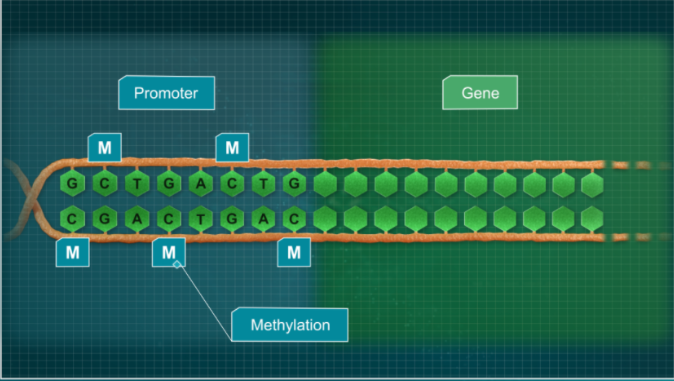
Gene PromoterA promoter is a sequence of DNA needed to turn a gene on or off. The process of transcription is initiated at the promoter. Usually found near the beginning of a gene, the promoter has a binding site for the enzyme used to make a messenger RNA (mRNA) molecule.24
The promoter region is the sequence typically referred to that's right upstream or right next to where a gene is about to be transcribed. It's the region where certain regulatory elements will bind; these are proteins that will bind to help RNA get transcribed. Now, "promoter", the term "promoter", can actually be a little bit of a nebulous term because it's not very exact. There are specific sequences that are generally found within a promoter region, but sometimes people refer to even extended promoter region that might include sequences that are farther upstream of the gene that might help enhance or repress the particular gene that's about to be transcribed in certain cell types. In general, if you think of the promoter as that piece of DNA that's just upstream of the transcription start site of a gene, that's pretty much what we refer to as promoters.24 | |
Gene sequences | |
Gene silencingInterruption or suppression of the expression of a gene at transcriptional or translational levels24.
| |
Gene’s reading frameIn molecular biology, a reading frame is a way of dividing the sequence of nucleotides in a nucleic acid (DNA or RNA) molecule into a set of consecutive, non-overlapping triplets. Where these triplets equate to amino acids or stop signals during translation, they are called codons27. | |
Genetic mutationAlso termed mutation1. Any change in the DNA sequence of a cell. Mutations may be caused by mistakes during cell division, or they may be caused by exposure to DNA-damaging agents in the environment. Mutations can be harmful, beneficial, or have no effect. If they occur in cells that make eggs or sperm, they can be inherited; if mutations occur in other types of cells, they are not inherited. Certain mutations may lead to cancer or other diseases. A mutation is sometimes called a variant1.
| |
Genetic testingThe process of analysing cells or tissue to look for changes in genes, chromosomes, or proteins that may be a sign of a disease or condition, such as cancer. These changes may also be a sign that a person has an increased risk of developing a specific disease or condition. Genetic testing may be done on tumour tissue to help diagnose cancer, plan treatment, or find out how well treatment is working1.
| |
GenomeThe complete set of DNA (genetic material) in an organism. In people, almost every cell in the body contains a complete copy of the genome. The genome contains all of the information needed for a person to develop and grow. Studying the genome may help researchers understand how different types of cancer form and respond to treatment. This may lead to new ways to diagnose, treat, and prevent cancer1. The genome is the entire set of genetic instructions found in a cell. In humans, the genome consists of 23 pairs of chromosomes, found in the nucleus, as well as a small chromosome found in the cells' mitochondria. Each set of 23 chromosomes contains approximately 3.1 billion bases of DNA sequence24.
| |
GenomicsStudy of the structure of the genome of particular organisms, including mapping and sequencing26. The study of all of the nucleotide sequences, including structural genes, regulatory sequences, and noncoding DNA segments, in the chromosomes of an organism27. | |
GenotypingA laboratory process in which an individual’s germline DNA is analysed for specific nucleotides or bases to determine whether certain variants are present. Genotyping differs from sequencing in which all of the nucleotides comprising a specific length of DNA are assessed (e.g. within a gene, exome, or genome)1.
| |
Germinal mutationAlteration in the genetic constitution of the reproductive cells, occurring in the cell divisions that result in sperm and eggs. Germinal mutations can be caused by radiation or chemical mutagens and may affect a single gene or an entire chromosome. A germinal mutation affects the progeny of the individual in whose reproductive cells the mutation arose and subsequent generations of that progeny26.
| |
GermlineThe cells from which eggs or sperm (i.e. gametes) are derived1. | |
Germline mutationA gene change in a body's reproductive cell (egg or sperm) that becomes incorporated into the DNA of every cell in the body of the offspring. Germline mutations are passed on from parents to offspring. Also called germline variant1.
| |
Germline variantA gene change in a reproductive cell (egg or sperm) that becomes incorporated into the DNA of every cell in the body of the offspring. A variant (or mutation) contained within the germline can be passed from parent to offspring, and is, therefore, hereditary. Also called germline mutation.1.
| |
GlandAn organ that makes one or more substances, such as hormones, digestive juices, sweat, tears, saliva, or milk. Endocrine glands release the substances directly into the bloodstream. Exocrine glands release the substances into a duct or opening to the inside or outside of the body1. | |
Glutamic acidA non-essential amino acid naturally occurring in the L-form. Glutamic acid is the most common excitatory neurotransmitter in the central nervous system24.
| |